Claudio Arrau, renowned throughout the world as one of the
supreme keyboard masters of the century, stands today at the summit of
his long and legendary career, for the one artistic goal he has pursued
for a lifetime: the total fusion of virtuosity and meaning.
Where other famous pianists play the piano for excitement,
power or display, Arrau plays to probe, to divine, to interpret. Says
Arrau, "An interpreter must give his blood to the work interpreted."
The famed late doyen of London music critics, Sir Neville
Cardus of the Guardian, explained Arrau vividly: "Arrau is the complete
pianist. He can revel in the keyboard for its own pianistic sake,
representing to us the instrument's range and power, but he can also go
beyond piano playing as we are led by his art to the secret chambers of
the creative imagination."
In a tribute by the Berlin Philharmonic, which bestowed the
Hans von Bulow Medal on Arrau in 1980, on the occasion of the 60th
Anniversary of his debut with that great orchestra, it was put even
better: "When Arrau bends over the keyboard, it is as if Music and only
Music itself, is flowing out of his entire body. There is not a nuance
of feeling or sound that he has not mastered. His pianissimo is more
eloquent, more mysterious than that of others, and his fortissimo has
more depth of dimension and is more limitless."
But a London Sunday Times interview some years back
explained the Arrau mystique best of all: "One regards him as a sort of
miracle; the piano is the most machinelike of instruments except the
organ - all those rods, levers, little felt pads, wires, no intimate
subtle human connection with it by breath, tongueing, or the string
player's direct engagement with speaking vibrations. But Arrau makes it
live, like God teaching Adam on Michelangelo's Sistine Chapel roof;
liquid, mysterious, profound, alive."
At 86, Arrau today is a legend in his own lifetime, not
only for the penetrating profundity of his interpretations, but for a
still transcendent virtuosity completely at the service of his art.
Explains Arrau: "Since in music we deal with notes, not words, with
chords, with transitions, with color and expression, the musical meaning
always based on those notes as written and nothing else - has to be
divined. Therefore any musician, no matter how great an instrumentalist,
who is not also an interpreter of a divinatory order, the way
Furtwangler was, or Fischer-Dieskau is, is somehow onesided, somehow
without spiritual grandeur."
Arrau is definitely not onesided or without spiritual
grandeur. Having won particular fame as a great Beethoven interpreter,
he is no less celebrated for his Mozart, Schubert, Chopin, Liszt,
Schumann, Brahms and Debussy. Among the famed peers of his generation,
it is a range without equal.
As a Beethoven interpreter, Arrau has played cycles of the
sonata and concertos throughout the world. During the Beethoven
Bicentennial Year, he played the five piano concertos in London for the
fifth time around and the "Emperor" Concerto in New York, London,
Berlin, at the Casals Festival, at the Bonn Festival and Beethoven
recitals everywhere, including New York, London, Paris, Berlin,
Amsterdam and Zurich. He has played cycles of the complete 32 piano
sonatas in New York, London, Buenos Aires, Berlin, Mexico City and most
of the sonatas in Zurich, Paris and Hamburg.
The Arrau discography is equally vast. His recordings
include the 32 Beethoven Piano Sonatas, the five Beethoven Piano
Concertos (thrice), the two Brahms Concertos (twice) and the complete
works for piano and orchestra by Chopin - all on Philips Records and
released throughout the world. He has also recorded a great many of the
solo works of Chopin, Schumann, Brahms, Debussy, Schubert and Liszt,
including the awesome 12 Transcendental Etudes, a feat which he pulled
off in time for his 75th birthday celebrations. Since then, he has
recorded the Tchaikovsky Piano Concerto No. 1 with the Boston Symphony
under Sir Colin Davis, the Liszt Concertos and (for the fourth time
around) the Grieg and Schumann Concertos, also with the Boston Symphony
under Sir Colin Davis. For his 80th birthday celebrations in 1983,
Philips Records brought out The Arrau Edition, 59 records in 8 deluxe
boxes, CBS brought out a 3-record Retrospective box as did EMI, and RCA
later brought out a 2-CD set consisting of Bach's "Goldberg" Variations
and the Chromatic Fantasy and Fugue, recorded in 1941. Recently, he
recorded the Beethoven Piano Concertos for the third time around, this
time with the Dresden Staatskapelle under Sir Colin Davis, 12 new
Beethoven Sonatas (which may form a new set of the 32), the Diabelli
Variations and the complete Mozart Piano Sonatas.
Without giving up Liszt, Arrau gravitated to Beethoven.
Textual fidelity and freedom of expression became his two guiding
principles. In starving Germany, he managed to keep himself and his
family alive, and by the time he won the famed International Geneva
Prize in 1927, when he was 24 (the judges were Cortot, de Motta and
Arthur Rubinstein), the great composers - Bach, Beethoven, Mozart,
Schubert - had become his life. By the time Arrau was 32, he had not
only played the 32 Beethoven Sonatas and all the Schubert and Mozart
Sonatas as well as Weber in cycles of concerts, but also, all of the
keyboard works of Bach in a series of 12 recitals which made him a
legend in Berlin.
During that time, he was also playing Schumann, Brahms,
Chopin, Liszt, Debussy, Albeniz, Ravel and Schoenberg, leading the chief
music critic of the London Times, William Mann to write years later
after World War II, "There are pianists who rank as outstanding in Bach,
Mozart, Beethoven, Chopin and Liszt. Arrau is the only pianist alive
who, at any rate while he is playing, can convince people that he is the
outstanding interpreter of all these composers and a good many others
too."
By the time Arrau returned to play at Carnegie Hall again,
in February 1941, he felt ready and mature, and this time, his name had
preceded him and the house was packed. The New York Times, along with
every other paper including Time Magazine, gave him rave reviews. The
following season he played over 100 concerts across the United States
and Canada and had the additional distinction of being invited back to
play twice in that same season with both the Boston and Chicago Symphony
Orchestras.
Today, Arrau's schedule of concerts still covers two and
three continents and sometimes even more, as it did in 1958 when his
world tour included the Soviet Union, Japan, Australia and New Zealand,
as well as Europe, Israel, the United States, Canada, Mexico and South
America - a tour which he repeated for the most part in 1974-75. In
fact, with the exception of Peking, there is probably not an important
city, large or small, anywhere in the world where Arrau has not been
heard. During the 1981-82 season, in addition to the United States,
Canada, Europe and Brazil, he also made his fifth return to Japan,
capping it with a sixth triumphant return to Japan and South Korea in
May 1987.
During 1982-83, the whole world of music joined in
celebrating the Maestro's 80th birthday. His Avery Fisher Hall recital
at Lincoln Center in February was the official birthday celebration and
was televised as was the concert with the Philadelphia Orchestra under
Riccardo Muti on the actual birthday, February 6th. There were also TV
documentaries both in London and Germany. He also picked up a new batch
of birthday honors and prizes, including the International UNESCO Music
Prize for 1983, the National Arts Prize from Chile, the Aztec Eagle from
Mexico, a Commandatore from the Accademia di Santa Cecilia in Rome and a
Commandeur de la l'Legion de Honneur, France's highest decoration.
As part of the continuing 80th birthday celebrations, Arrau
returned to his native Chile in May 1984 as a symbol of peace after an
absence of 17 years, to play as he said, "For a whole new generation
which has never heard me," and was given a reception probably without
equal since the time of Paderewski's return to Poland after World War I
and Liszt's return to Hungary under the Austrians in 1839. As the New
York Times reported in a long story which was given an alert on the
front page, Arrau dominated the local newspapers for weeks and his
concerts in Santiago (six in eleven days) were seen and heard on TV by
80% of the nation. Until recently playing up to 100 concerts each
season, Arrau has now reduced the number to around 50, leaving himself
more time to record, study and read, a lifelong passion. His fervent
wish: "Another hundred years just to read."
His 85th birthday, on February 6, 1988, was another
occasion for world celebration, winding up with a grand "Emperor"
Concerto in London, under the direction of Sir Colin Davis, which was
televised and will be brought out on video disc together with the
Beethoven Concerto No. 4 under Riccardo Muti. Since 1941, Arrau and
his late wife Ruth, made Douglaston, New York, their home base and also
a summer home in Vermont, where he loves to retreat for rest and quiet,
sometimes with his children and grandchildren and always with his
beloved cats and dogs. Arrau became an American citizen in February
1979, but retains dual passports.
In 1978, Arrau completed a new Urtext Edition of the
Beethoven Piano Sonatas for the famous music publishing house of Peters
in Frankfurt. A performing edition, the first by a famous Beethoven
interpreter since Schnabel's in 1935, it includes all the Arrau
fingerings, as well as tempi by Beethoven (where available), Czerny and
Arrau and suggestions for dynamics, pedalings and performance practice.
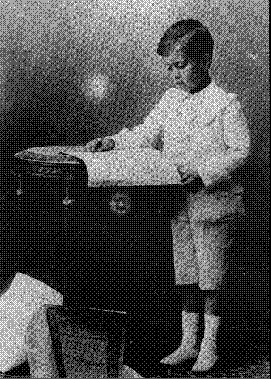
Claudio Arrau was born in Chillan Chile, on February 6,
1903 and like most of history's great pianists, was a child prodigy. His
mother was an amateur pianist and his father an eye doctor, who died in
a riding accident when Arrau was one-year old. In order to support
herself and her three young children, Lucretia Leon de Arrau, an
indomitable woman, began to give piano lessons. Claudio, her youngest,
was allowed to sit in so she could keep an eye on him and the result was
that he could read notes before he could read words. By five, the boy
gave recitals both in Chillan and in Santiago and by seven, he and his
entire family, including an aunt, were on their way to Berlin (the
musical Mecca of that time) where the young piano genius was to study on
a Government grant (by an act of the Chilean Congress) over the next
ten years. In Berlin, after blundering around for two years with
wrong teachers, Arrau, at ten, finally found the teacher he needed. He
was Martin Krause, a pupil of Liszt's, a famous music critic and the
friend of all the great musicians of his time. Between the young boy and
the grand pedagogue, it was love at first sight. For Arrau, Krause
became the father he never had and to Krause, Arrau was the pupil he had
been searching for. "He will be my masterwork," said Krause, who also
taught Edwin Fischer.
In Berlin, the young boy heard all the great pianists of
the day; Terese Carreno, d'Albert and later, Busoni, and they all became
his idols, especially Carreno and Busoni. At 15, when Krause died from
the great flu epidemic of1918, Arrau was 1eft without a teacher. But so
much had been imparted to him that he preferred to go on by himself,
winning the famed Liszt Prize twice in a row at ages 16 and 17.
Thus, when Arrau, at 20, arrived for his Carnegie Hall
debut on October 20, 1923, he was already a seasoned artist who had
played throughout Europe since the age of 11, had appeared with Nikisch
in Leipzig at 12, and at 17, had made smash debuts both in London (at
the Royal Albert Hall) and in Berlin with the Berlin Philharmonic under
Karl Muck.
Arrau had come to the United States for a promised tour of
30 dates and found himself with only five (in those days things like
that happened even to veterans like Carreno and Busoni): three concerts
in New York and appearances with the Boston and Chicago Symphonies.
Boston under Monteux and Chicago under Stock were splendid. Carnegie
Hall, with the house mostly empty, was far less so. Arrau, thinking
himself a failure, returned home to Berlin no richer than he had come,
and that, he says today, was probably the best thing that could have
happened to him at the time, artistically-wise.
Berlin, after World War I, was boiling over with new ideas.
The time of the salon pianists was about over, musicology was a new
discipline and great Beethoven interpreters were coming to the fore who
were to transform the art of piano playing in our time. The spirit of
Busoni, d'Albert and Ansorge were still everywhere, Schnabel and Edwin
Fischer were on the rise, and both freedom of expression and fidelity to
the text were the order of the day.


